Determining the tactics of managing patients with scars is fundamental to achieving treatment results. In order to correct scars, injection (collagen preparations, plasma therapy, hyaluronidase and betamethasone dipropionate injections, etc.), instrumental (erbium and CO 2 lasers, neodymium laser, photodynamic therapy, needle RF), physiotherapeutic (electrophoresis, laserphoresis) methods and external therapy are used.
A scar is a dense fibrous connective tissue formed because of the pathological process of healing skin damage due to inflammation, trauma and burns. From the definition, it is clear that this condition is atypical for the patient, often leading to psychological discomfort.
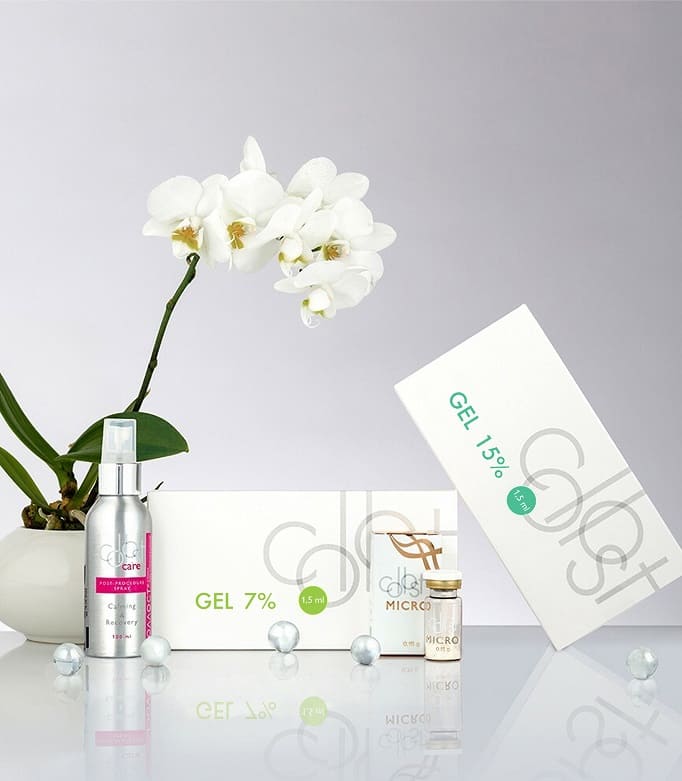
One of the effective methods for scar correction is injections of products from COLLOST® line: COLLOST® gel 7 %, 15 %, COLLOST® micro. The introduction of collagen fibers purified from additional cells serves as a directed matrix for the migration of fibroblasts and the initiation of the synthesis of own collagen fibers, accelerating the regeneration process [1, 2, 3].
In atrophic scars, the dermis is thinned, sometimes practically absent, which leads to a lack of conditions for the normal functioning of fibroblasts and tissue restoration. It is also known that from the age of 20–25, fibroblast activity decreases, leading to a slowdown in the skin recovery process after injury.
Native collagen fibers are capable of binding and protecting enzymes and physiologically active substances involved in the wound healing process from destruction: neutrophil elastase, matrix metalloprotease-2, interleukins-6, -8 and -1, superoxide anion, peroxynitrate [4]. In a study of endothelial cells of dermal microvessels, native collagen caused activation of angiogenesis [5].
COLLOST® preparations are collagen type I fibers obtained from the skin of a young bull. The manufacturing process removes dermal cells without destroying the collagen matrix, resulting in a non-immunogenic, inert and durable material. As a result of histological and ultrasonic studies, it was shown that after injections of the product, there is an increase in echogenicity, an increase in the thickness and number of small vessels of the dermis, an increase in neoangiogenesis, while no inflammatory reaction is observed, the structure of the epidermis is not disturbed.
• Atrophic and hypotrophic scars.
• Striae (pink and red).
• Correction of scars after plastic surgery.
• Post-burn scars.
• Post-acne scars.
• Post-inflammatory scars.
• Preparing patients for instrumental correction
of scars (laser resurfacing, needle RF).
• Restoration of tissue atrophy after
administration of betamethasone dipropionate.
The procedure of injections of COLLOST® preparations is contraindicated in keloid scars.
Scar correction is performed regardless of how long the scar has existed: both fresh scars during the first days of their appearance, and old scars more than 10 years old.
The product is administered using the linear injection technique; the product is administered over the entire surface of the scar, with the obligatory inclusion of surrounding tissues. A 27–30G needle is used for injection. If necessary, scar separation is performed.
Injections of COLLOST® preparations for the treatment of scars are combined with instrumental and injection techniques:
• COLLOST® gel 7%, 15% is used for preparation and recovery after hardware techniques (laser resurfacing, needle RF);
• COLLOST® micro can be hydrated with PRP and sodium citrate.
The procedures are carried out at intervals of 2-3 weeks, the number of procedures is selected individually until the result is achieved.
PATIENT N., 35 years old, visited us with complaints of scars in the area of the lower eyelid and scalp, dark circles under the eyes, pain, and a feeling of tension. It is known from the anamnesis that 3 weeks ago the patient underwent lower blepharoplasty and a circular lift. After the operations, the patient noted a pronounced feeling of tension in the area of the right lower eyelid and scalp. The surgeon injected the product betamethasone dipropionate into the area of the lower eyelids (right and left), as a result of which, after 7 days, tissue depression appeared in this area.
At the time of examination, fresh normotrophic scars are noted in the scalp area (Fig. 1A) , subjectively there is a feeling of pain and tension in this area. In the area of the right and left lower eyelids, thinning of the subcutaneous fat tissue and dark circles are noted (Fig. 1B) .
Treatment tactics:
1. PRP therapy with an interval of 1 week, 2-3 procedures. The goal is to reduce inflammation, tension, and prepare for collagen therapy.
2. Collagen therapy with COLLOST® 7 % gel once every 2 weeks, 3–4 procedures.
After the first procedure, a decrease in pain and tension in the scalp area is noted. As a result of the course, the size of the scar in the scalp area decreased, and the scar became less noticeable visually (Fig. 1B). In the area of the lower eyelids, the skin became denser, and dark circles also became less noticeable.
PATIENT S., 30 years old, visited us with complaints on the presence of scars after mammoplasty, a feeling of tightness under the mammary gland, striae in the area of the mammary glands.
It is known from the anamnesis that an anchor breast lift was performed.
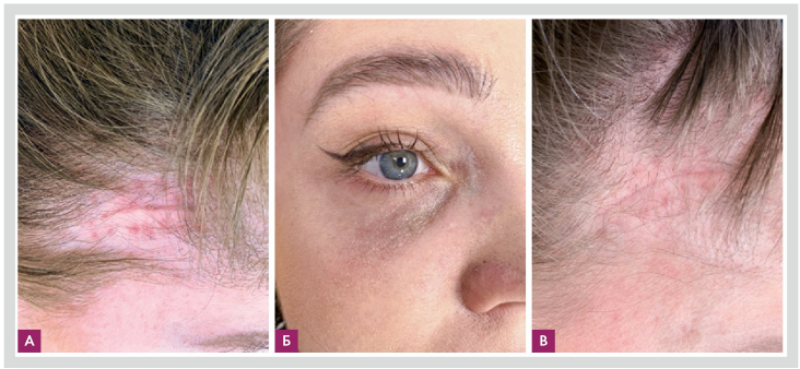
Fig. 1. Patient N., 35 years old: scar in the scalp area after a circular facelift (A); tissue depression after injections of betamethasone dipropionate (B); scar in the scalp area after 2 PRP therapy procedures and 2 collagen therapy procedures with COLLOST® gel 7 % (B)

Fig. 2. Patient S., 30 years old. Scar after mammoplasty before the start of the course of treatment (A); scar after the first PRP therapy procedure and 2 collagen therapy procedures with COLLOST® micro, hydration with 0.9 % NaCl solution 3 ml and 2 ml PRP with sodium citrate (B)
At the time of examination, pink scars are noted in the area of the operation, atrophic scars in the area of the mammary glands (Fig. 2A) .
Treatment tactics:
1. PRP therapy with an interval of 1 week, 1 procedure. The goal is to reduce inflammation, tension, and prepare for collagen therapy.
2. Collagen therapy with COLLOST® micro product, hydration with 0.9 % NaCl solution 3 ml and 2 ml PRP with sodium citrate.
Injections are performed in the area of scars after anchor lifting once every 2 weeks. Number of procedures – until the result is achieved. Atrophic scars (striae) are also treated using the linear injection technique. In case of treatment of scars and striae, 2 bottles of COLLOST® micro are used. After the course of procedures, the scars become pale, their width decreases, and they become elevated relative to the surrounding tissues (Fig. 2B).
Carrying out collagen therapy procedures for scars using the COLLOST® product line allows the following:
• accelerates epithelial, epidermal and endothelial regeneration;
• stimulates the process of angiogenesis;
• provides a hemostatic effect;
• reduces the healing time of damaged tissues;
• reduces the possibility of formation of rough skin scars;
• prepares the skin for aggressive procedures;
• reduces skin recovery time after aggressive procedures.
Write to us and our specialists respond as soon as possible