Intradermal collagen-based implant COLLOST® Micro and Intradermal collagen-based implant COLLOST® Intense are new medical devices that are sterile, completely biodegradable materials consisting of micronized Type I collagen. The implants are intended for intradermal injection for the purpose of correction the manifestations of physiological and pathological skin atrophy. The scope of medical application of implants: cosmetology, dermatology and plastic surgery. The devices vary in the form of release of collagen material (Fig. 1). In «COLLOST® Micro» finely dispersed micronized collagen is packed into sealed glass vials and requires hydration with normal saline solution or autologous patient blood plasma, followed by transfer of the material into a syringe, before use. In «COLLOST® Intense» similar micronized collagen is pre-dispersed in normal saline solution and pre-packed into a syringe.
Evaluation of the sensitizing properties of the developed medical devices that come into contact with human tissues is a mandatory stage of preclinical studies (GOST ISO 10993-1-2011). In this regard, the goal of this study was to investigate the sensitizing effect of the medical devices: “Intradermal collagen-based implant COLLOST® micro” and “Intradermal collagen-based implant COLLOST® intense”.
Regulatory documentation. The study was conducted in accordance with GOST 33044- 2014, according to the study plan drawn up taking into account GOST R ISO 10993-2-2009, GOST R ISO 10993-10-2011.
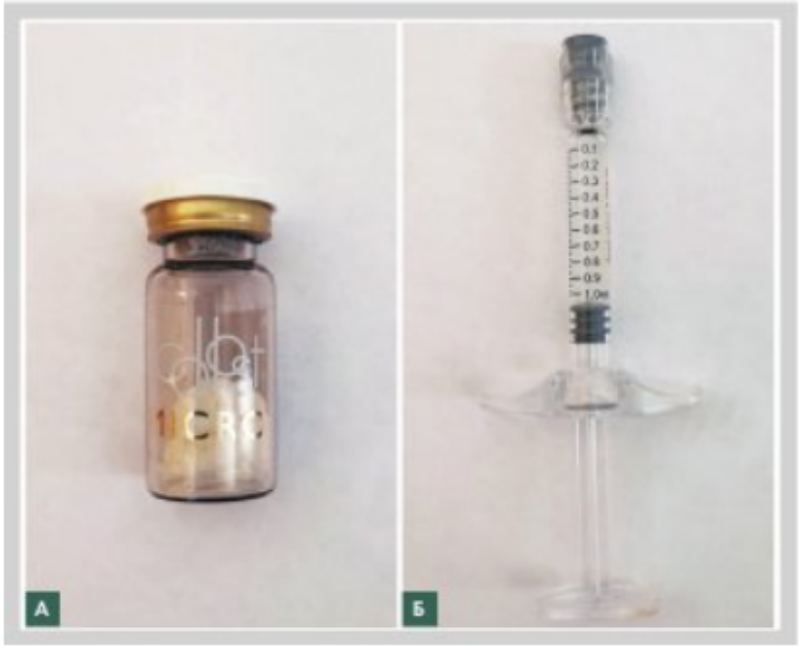
Fig. 1. Trial medicinal products in primary packaging: “Intradermal collagen-based implant COLLOST® micro” (А) and “Intradermal collagen-based implant COLLOST® intense” (Б)
Object of the study. The following medical devices were studied 1) “Intradermal collagenbased implant COLLOST® micro” manufactured according to TU 32.50.22-004 56533116-2019, batch No. 001012020, manufacturing date — 01/15/2020, expiry date 01/15/2025; 2) “Intradermal collagen-based implant COLLOST® intense” manufactured according to TU 21.10.60-003-56533116-2019, batch No. 009062020, manufacturing date 06/23/2020, expiry date 06/23/2023. Manufacturer of the medical devices: BioPHARMAHOLDING LLC.
Before testing, the medical devices were prepared according to the manufacturer’s instructions: the COLLOST® micro implant was hydrated with 5 ml of sterile 0.9% sodium chloride solution for injection and transferred to a sterile disposable syringe; the COLLOST® intense implant was removed from the refrigerator and kept at room temperature for 30 minutes.
Sterile 0.9% sodium chloride solution for injection manufactured by JSC DALHIMFARM was used as a control object (carrier) during the test, as well as for diluting the implant material during preparation of doses/concentrations.
Laboratory animals. The study was conducted on laboratory animals: Balb/c mice (n=72) weighing 20-27 g and albino guinea pigs (n=46) weighing 370-510 g. The ratio of females to males was equal in all experiments. The animals were obtained from the nursery of the Federal State Budgetary Institution of Science Scientific Center for Biomedical Technology of the Federal Medical and Biological Agency of Russia, Andreevka branch. The mice and guinea pigs were kept in accordance with SP 2.2.1.3218-14 “Sanitary and Epidemiological Requirements for the Design, Equipment, and Maintenance of Experimental Biological Clinics (Vivariums)”, as well as the Guide for the Care and Use of Laboratory Animals of the US National Academy of Sciences [1]. All routine animal care procedures were performed in accordance with the vivarium standard operating procedures (SOPs) and their implementation was documented. Animals were housed in plastic cages with bedding (mice — 6 individuals, guinea pigs — 2-3 individuals). Environmental parameters were controlled: temperature 20-26 °C, humidity 30-70%, air exchange 15 volumes/hour, duration of the lighting period 12 hours. The animals received drinking water and standard granulated feed (OOO Laboratorkorm, Russia) ad libitum. Mice were quarantined for at least 14 days, and guinea pigs for at least 21 days. Before the experiments, animals were randomly assigned to groups by body weight so that differences in body weight between individuals of the same sex did not exceed 20%. All animals were euthanized by carbon dioxide inhalation.
All planned manipulations with experimental animals, requirements for the conditions of their feeding and maintenance were drawn up in the form of a veterinary protocol according to the standard form of the Bioethics Commission of the National Research Center for Toxicology and Hygienic Regulation of Biological Preparations (veterinary protocol No. 726, approved by the Bioethics Commission of the National Research Center for Toxicology and Hygienic Regulation of Biological Preparations on October 28, 2020). Only trained and qualified employees were involved in working with the animals. All manipulations with the animals were carried out only according to the procedures approved in the veterinary protocol, in compliance with the principles set out in EU Directive 86/609/EEC and the Helsinki Declaration of the World Medical Organization.
The ability of the tested medical devices to cause IHS was assessed in the active cutaneous anaphylaxis (ACA) reaction [2] after sensitization by triple injection. The study was conducted on Balb/c mice. For sensitization, medical devices were used in doses of 0.01 and 0.1 ml per individual, which is equivalent to the maximum and tenfold maximum therapeutic dose (TD) for humans, respectively. Each experimental group included five males and five females. Sensitization was carried out using the following scheme: 1st injection — subcutaneously, 2nd and 3rd ones — after 24 hours — intradermally. The animals of the control groups received the carrier according to the scheme of injection of the study objects. On the 14th-17th day after the last sensitizing injection, IHS was detected using ACA reaction. For this purpose, the mice of the experimental and control groups were intradermally injected with a resolving dose (RD) of the test objects (0.05 ml of undiluted implants) on the trimmed areas of the lateral surface of the body at two points (the RD of the test objects was selected in a preliminary experiment on 6 animals as not causing a nonspecific increase in the permeability of blood capillaries at the site of intradermal injection).
At the control site, the animals were injected with 0.05 ml of the carrier. After 20 minutes, the mice were injected intravenously with 0.2 ml of a 1% Evans blue solution; after 30 minutes, the animals were euthanized and the presence and size (if any) of a blue spot of exudate on the inner side of the skin at the RD injection site were determined. The reaction was considered positive if the spot diameter was at least 2 mm.
The ability of the tested medical devices to induce DHS was assessed using the maximum sensitizing effect method (GOST R ISO 10993-10-2011 [3]). This method includes combined sensitization (intradermal injection and cutaneous applications) at one concentration selected at the preliminary study stage for each route of administration, followed by detection of DHS during application of a provocative skin test. The study was conducted on albino guinea pigs. In the preliminary study, 8 guinea pigs were used for each test object (females to males ratio 1:1). After depilation, all guinea pigs were intradermally injected with 0.1 ml of complete Freund’s adjuvant (CFA) emulsion in saline (1:1). After this, four animals for each test object were injected with 0.1 ml of the medical devices intradermally in native form and in dilutions of 1:2 and 1:4. The remaining four guinea pigs received skin applications of 0.2 ml of the medical devices in native form and in dilutions of 1:2 and 1:4. The application site was covered with sterile gauze and secured with a fixing bandage. After 24 hours, the injection/application sites were semi-quantitatively assessed in accordance with the skin reaction classification system (Table 1).
Table 1. Skin reaction classification system (GOST R ISO 10993-10-2011, [3])

Based on the analysis, the concentrations of the materials for the main experiment were determined: for sensitization — the highest concentration that does not cause more than discrete or patchy erythema (no more than 1 point), for the provocative test — the highest concentration that does not cause erythema (0 points).
In the main experiment, each experimental group was represented by 10 animals (female to male ratio 1:1). Since the same carrier (0.9% sodium chloride solution) is used in the production and preparation for use of the tested medical devices, one control group was used for both devices.
To carry out sensitization, each animal was injected with the following products intradermally into the clipped areas of the skin on the back in two repetitions:
The volume of each injection was 0.1 ml. After 7 days, application of 0.2 ml of the tested medical devices was performed on the interscapular region of the back of the animals in the concentration selected at the stage of preliminary studies. 24 hours before the start of the applications, the skin areas were treated with 10% sodium lauryl sulfate in petroleum jelly. The application area was covered with sterile gauze and secured with a fixing bandage. The duration of the application was 48 hours. The control animals were applied with the carrier. Thirteen days after the completion of sensitization, DHS was detected using the provocative skin test. The concentration selected in the preliminary experiment was used. 0.2 ml of the medical devices were applied to the skin of the sides of the guinea pigs, the application sites were covered with sterile gauze and secured with a fixing bandage for 24 hours. Animals of the control group were given two provocative tests of each medical device on different areas. 24 and 48 hours after removing the bandage, the skin reaction to the provocative test was assessed in accordance with the skin reaction classification system (Table 1). The test was considered positive if the average semi-quantitative assessment in the experimental group was equal to or exceeded 1 point, while in the control group this indicator was less than 1 point.
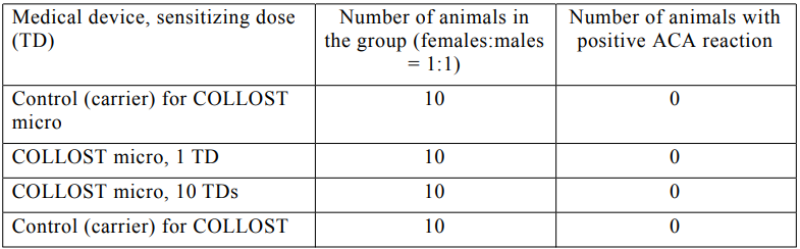
Study of the ability of the medical devices to cause immediate hypersensitivity (IHS). Analysis of skin flaps in the zones of injection of the medical devices resolving doses (RD) (Fig. 2) did not reveal the presence of exudate stained with Evans blue at all injection points in 100% of animals that received both COLLOST® micro and COLLOST® intense products, as well as in all animals of the corresponding control groups (Table 2). The obtained data indicate the absence of IHS to the medical devices [2] in this experimental model.
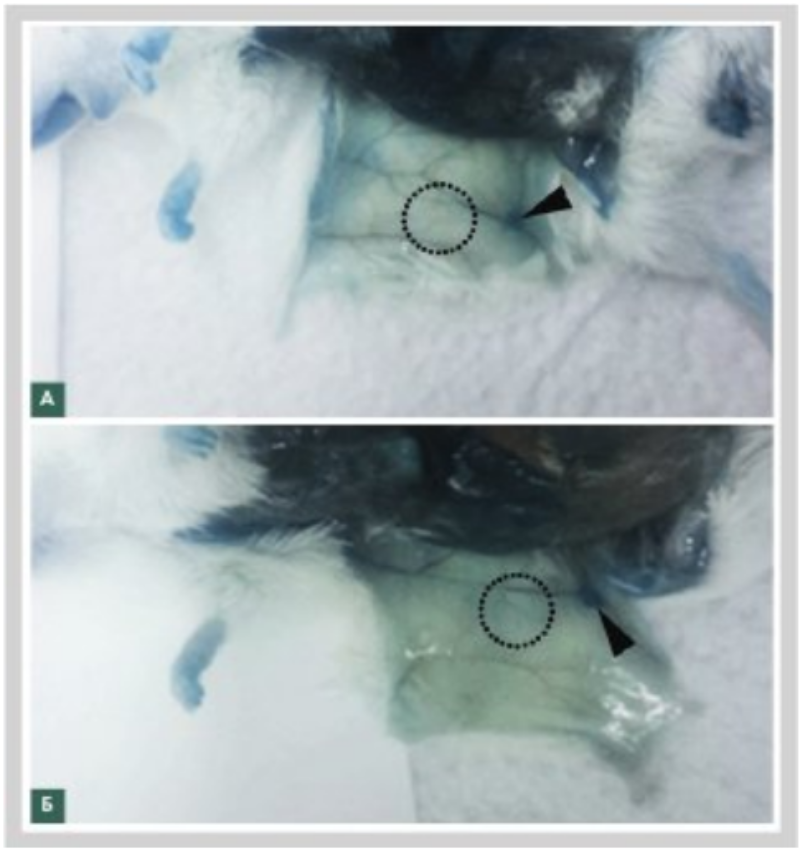
Fig. 2. Detection of IHS in ACA reaction after sensitization of Balb/c mice with «COLLOST® micro» (A) and «COLLOST® intense» (Б) medical devices. The dotted line marks the areas of the RD injection. Arrows indicate the inguinal lymph nodes (blue coloring indicates the presence of Evans blue dye in the bloodstream)
Table 2. Assessment of ACA reaction after sensitization of Balb/c mice with the medical devices

In a preliminary experiment, a selection of doses of the medical devices for intradermal injection and skin applications was carried out. The skin reaction (Table 1) after the medical devices intradermal injection and during their skin applications was assessed at 0 points both in native form and with dilutions in all animals. Based on the data obtained, it was concluded that both medical devices should be used in native form (without dilution) during sensitization in the main experiment both for intradermal injection and for skin applications. In this case, before conducting a provocative skin test (24 hours before) the skin areas should be treated with 10% sodium lauryl sulfate (dodecyl sulfate) solution in petroleum jelly in accordance with the requirements of GOST R ISO 10993-10-2011.
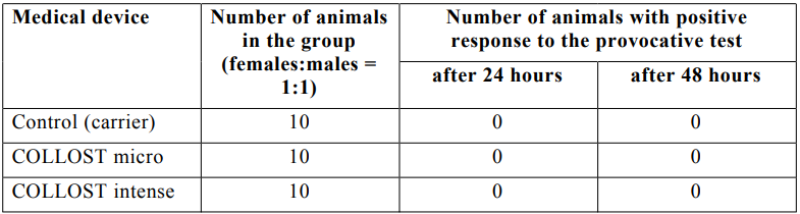
In the main experiment, assessment of the skin reaction (Table 1) to the provocative test 13 days after completion of sensitization did not reveal any differences between the control and experimental groups of animals (Table 3). The skin reaction in all guinea pigs was 0 points (no visible changes) 24 and 48 hours after exposure to the provocative test. The results of the study indicate the absence of the development of DHS to both medical devices in this experimental model (GOST R ISO 10993-10-2011, [3]).
The ability of the substances to cause a state of hypersensitivity when they enter the body — an excessive reaction of the immune system that causes harm to the body — is called sensitizing/allergenic properties [2], [4]. Allergic reactions are divided into those developing according to the «immediate» and «delayed» types. «Immediate» type reactions (IHS) are triggered by the interaction of antibodies with antigens and develop, as a rule, within 1-30 minutes after the antigen enters the body. «Delayed» type reactions (DHS) occur when the antigen interacts with T-lymphocytes and develop 24-48 hours after the antigen penetration [2], [4], [5].
Table 3. Assessment results of the provocative skin test of albino guinea pigs after combined sensitization with the medical devices for the purpose of detecting DHS
In this work, within the framework of pre-clinical trials of new implantable bioresorbable collagen-based medical devices, their ability to induce IHS and DHS in vivo was investigated in laboratory animals. It was not possible to use simpler test systems to achieve the aim of the study, since the formation of hypersensitivity cannot be fully assessed on models that are simpler than living animals. As a rule, the study of the sensitizing properties of medical devices is carried out using their extracts obtained by incubating the devices in liquids (GOST R ISO 10993-12-2011). However, in relation to the tested injection implants , the use of this approach to the study was incorrect, in our opinion, due to the fact that their main structural component — collagen protein is poorly soluble in the extracting liquids recommended by GOST R ISO 10993-12-2011. In addition, the form of the medical devices — injection implants allows them to be directly introduced into animal tissues in various dosages, which will obviously better reproduce the conditions of their use in clinical practice. In this regard, the object of the study in this work was not extracts, but implanted material of medical devices.
To study DHS reactions, GOST R ISO 10993-10-2011 suggests using the method of maximum sensitizing effect [3] or the method of closed cutaneous applications [6]. The method of maximum sensitizing effect was chosen for conducting this study due to the fact that it involves combined sensitization, including intradermal injection of test objects, which better reflects the method of using the medical devices in the clinic than sensitization using skin applications only.
GOST R ISO 10993-10-2011 does not describe methods for studying IHS that include sensitization using intradermal or subcutaneous injections. In this regard, the ACA method, widely used in preclinical studies of medicinal products, was used to assess the ability of the medical devices to induce IHS [2]. Results of in vivo experiments conducted did not reveal the development of IHS and DHS reactions in any of the animals in the experimental groups that received either “Collagenbased intradermal implant COLLOST® micro” or “Collagen-based intradermal implant COLLOST® intense”.
The obtained data indicate the absence of a sensitizing effect of the studied medical devices in preclinical animal models, which allows for further studies of their safety.
The medical devices “Collagen-based intradermal implant COLLOST® micro” or “Collagenbased intradermal implant COLLOST® intense” do not have a sensitizing effect in the preclinical models in vivo. The data obtained support safety of the injection implants studied.


Write to us and our specialists respond as soon as possible