Abstract
Allergenic and genotoxic effects of the medical device «Resorbable collagen material COLLOST® gel» were studied in laboratory animals. It was shown than immediate hypersensitivity reaction is not detected in mice by the cutaneous anaphylaxis test after once weekly sensitization during 30 days. Conjunctival test revealed no hypersensitivity to medical device in guinea pigs after three times sensitization for every 48 hours. Guinea pig maximization test did not reveal any skin-sensitizing effect of the medical device. Bone marrow chromosome aberration test did not detect genotoxic effects of the medical device.
Injectable biocompatible materials have been used for a long time in aesthetic surgery and cosmetology to correct age-related and atrophic changes in the skin. Medical products and preparations of this type are most effective in correcting nasolabial folds and wrinkles in the lower third of the face, as well as in the treatment of atrophic scars caused by acne, trauma or surgery [1]. The main components of injection implants are various native or chemically modified substances of biological (collagen, hyaluronic acid) and synthetic (poly-lactic acid, calcium hydroxyapatite, polymethyl methacrylate, etc.) origin [2]. Among them, collagen, which is the main protein of the fibrous extracellular matrix [3], has the longest history of widespread clinical use. Thus, Zyderm I injection implant (Inamed Aesthetics, USA) based on type I collagen obtained from cattle hides was developed in 1976 and approved for use by the US Food and Drug Administration (FDA) in 1981 [1]. Clinical trial data, as well as extensive practical experience, indicate the high efficiency and safety of injectable collagen materials [4-8].
Biocompatibility, the ability to controlled biodegradation and induction of autologous connective tissue formation in this process, the ability to act as a matrix for cellular migration [9-11], determine the popularity of collagen as a component of implants. At the same time, the predominant use of xenogenic collagen (primarily from bovine collagen) for the production of injection materials is considered to be the main reason for the occurrence of allergic reactions observed in a small proportion of patients [12]. In particular, according to various literature data, Zyderm brand implants cause the development of hypersensitivity reactions (redness, swelling, hardening, itching of the skin, urticaria) in 1-5% of patients [1, 2, 12, 13]. In addition to allergic reactions, during long-term clinical use of bovine collagen-based implants, the occurrence of granulomatous tissue reactions in the injection area was recorded in rare cases [14], and a possible connection was noted between the introduction of collagen dermal implants and the possibility of developing dermatomyositis [15].
The accumulated clinical data on the biological properties and possible side effects of injection materials based on xenogenic collagen attract additional attention to issues related to their safety testing. This paper presents the results of a study of the allergenic and genotoxic effects of a domestic injection medical device based on native bovine dermal collagen, «COLLOST® ReResorbable Collagen Material» in the form of a 7% gel, in models in vivo.
The experiments were planned and conducted in strict accordance with the Rules of Good Laboratory Practice (GLP) approved by GOST 33044-2014 [16] and the order of the Ministry of Health and Social Development of the Russian Federation dated 01.04.2016, No. 119n [17]. The object of the study was the medical product «COLLOST® reresorbable collagen material, gel». Presentation — sterile 7% gel in 3 ml syringes with a stopper. Gel composition: 7% (by weight) native type 1 collagen, unreconstructed from cattle hides in 10% glucose solution for infusions. Manufacturer — BioPHARMAHOLDING LLC, Russia. Batch No. 2 Expiry date15.01.18.
The study of the allergenic and genotoxic effects of this medical device was conducted on models in vivo recommended in GOST ISO 10993-3-2011 [18], GOST ISO 10993-10-2011 [19], as well as in the «Guidelines for the conduct of preclinical studies of medicinal products» edited by A.N. Mironov [20]. The choice of the administered doses of the device was carried out in accordance with the specified GOSTs, as well as the Directives of the Organization for Economic Cooperation and Development (OECD) No. 474, 475 [21, 22]. Laboratory animals. For the experiments, mice of the Balb/c (n=30) and C57B1/6 (n=50) lines, as well as albino guinea pigs (n=46) in equal proportions by sex, obtained from the nursery of the Federal State Budgetary Scientific Institution Scientific Center for Biomedical Technologies of the Federal Medical and Biological Agency of Russia, Andreevka branch (Solnechnogorsk district, Moscow region) were used. The animals were kept in Plexiglass cages with bedding made of deciduous tree shavings (Laboratorkorm, Russia) at controlled temperature (20-26 °С), humidity (30-70%) and air exchange (15 volumes/h) values, with equal duration (12 h) of light and dark periods, as well as with unlimited access to drinking water and standard granulated feed for laboratory rodents (Laboratorkorm, Russia). Before the experiments, the animals were randomized by body weight. All animals were withdrawn from the experiments by inhalation exposure to carbon dioxide.
Ensuring compliance with the Principles of humane treatment of experimental animals. The justification for using laboratory animals in the study, the sample size, intravital manipulations, and the method of animals’ withdrawal from the experiment were reviewed and approved by the Bioethics Commission of the Research Center for Tuberculosis and Blood Transplantation — a Branch of the Federal State Budgetary Institution “State Research Center Institute of Immunology” of the Federal Medical and Biological Agency of Russia (protocols No. 530, 531 dated May 29, 2015).
Study of allergenic effect
To evaluate the allergenic effect of collagen gel, its ability to cause immediate hypersensitivity (IHS) in mice with a course of administration (experiment No. 1) and in guinea pigs with three-time intradermal administration (experiment No. 2) was studied. In addition, the ability of the medical product to form delayed hypersensitivity (DHS) in guinea pigs was studied using the maximum sensitizing effect method (experiment No. 3). In experiments No. 1 and No. 2, the experimental and control groups consisted of 10 animals with an equal ratio by sex. In experiment No. 3, the experimental group consisted of 10 animals, and the control group consisted of 6 animals, also with an equal ratio by sex. In all experiments, the animals of the control groups were injected with 0.1 ml of 10 % glucose solution for infusions (MOSFARM LLC, Russia) instead of the gel according to a similar scheme.
Experiment No. 1 Two experimental groups of Balb/c mice were injected intradermally with 0.1 ml and 0.025 ml of the gel once a week for a month. Fourteen days after the last injection, an active cutaneous anaphylaxis reaction was performed to detect sensitization. For this purpose, all animals were injected intradermally with 0.05 ml of the gel on one of the lateral surfaces of the body. On the other lateral surface of the body, a 10% glucose solution was injected in the same volume. After 20 minutes, 0.2 ml of 1% Evans blue solution (Dia-M, made in the USA) was injected into the tail vein. After 30 minutes, the animals were taken out of the experiment and the diameter of the spot formed by the exudate stained with Evans blue on the inner surface of the skin at the injection sites was assessed.
Experiment No. 2 Two experimental groups of albino guinea pigs were injected intradermally with 0.1 ml and 0.025 ml of the gel three times with an interval of 48 hours. Twenty days after the last injection, the animals were tested using the conjunctival test to detect sensitization. For this, all guinea pigs were injected under the upper eyelid with 0.05 ml of gel, and the same volume of 10% glucose solution was injected into the second eye (control). The reaction was assessed visually after 1, 24, 48 hours, using a semi-quantitative (point) assessment system: 0 — no visible changes in the condition of the sclera and conjunctiva, 1 — slight reddening of the lacrimal duct, 2 — reddening of the lacrimal duct and sclera, 3 — reddening of the entire conjunctiva and sclera.
Experiment No. 3 Each guinea pig in the experimental group was injected with 0.1 ml of: 1) complete Freund’s adjuvant (CFA), 2) gel, 3) gel mixed with CFA in a ratio of 1:1 intradermally into the trimmed areas of the skin on the back in two repetitions. After 7 days, all animals in the experimental group were given an application of gel for 48 hours (1.5 ml/individual) to the interscapular region of the back. Animals in the control group were given the same volume of 10 % glucose solution. The application area was treated with 10 % sodium lauryl sulfate solution in petroleum jelly for 24 hours, since, the gel did not cause any visible changes in the skin condition in the preliminary experiment when selecting the application dose. After 14 days, a provocative test was performed to detect sensitization of the animals. For this purpose, 1.5 ml of gel was applied to the skin of the lateral part of the body of all animals, which was not used for injections and applications, and secured with a fixing bandage for 24 hours. Then the fixing bandage was removed and the condition of the skin was visually assessed immediately after removal, after 24, 48 and 72 hours, using a semi-quantitative assessment system: 0 — no visible changes, 1 — discrete or focal erythema, 2 — moderate and continuous erythema, 3 — intense erythema and swelling.
Study of genotoxic effect
To assess the genotoxic effect of collagen gel, its ability to cause chromosomal aberrations in bone marrow cells of C57B1/6 mice was studied (experiment No. 4). Three experimental groups, as well as positive and negative control groups, consisted of 10 animals with an equal ratio by sex.
Experiment No. 4 Mice in the experimental groups were injected with collagen gel intradermally at a dose of 2000 mg/kg of body weight. Two experimental groups were injected with the gel once. In this case, the animals were withdrawn from the experiment and bone marrow was collected after 24 and 48 hours, respectively. One experimental group was injected with the gel in a course of 3 times a week for 14 days. Bone marrow was collected 24 hours after the last injection. The negative control group was given a single intradermal injection of 10% glucose solution (in an amount similar to the volume of gel given to the experimental groups), the positive control group was given a single intraperitoneal injection of cyclophosphamide (LENS-Pharm LLC, Russia) at a dose of 20 mg/kg; in both cases, bone marrow was isolated for analysis 24 hours after the injection. Three hours before withdrawal from the experiment, all animals were given an intraperitoneal injection of 0.025 % colchicine solution (PanEco Research and Production Enterprise, Russia) in a volume of 0.25 ml. After the mice were withdrawn from the experiment, bone marrow cells were isolated from the femurs and preparations of their metaphase chromosomes were prepared using the standard dry-air method [23]. The obtained preparations were subjected to cytogenetic examination. 100 metaphases from each animal were analyzed. The number of single and paired fragments, chromatid and chromosome exchanges, achromatic gaps, and the number of metaphase plates with multiple chromosome damage were counted.
Statistical processing of data
Statistical processing of the obtained numerical data was performed using the STATISTICA 10 and SPSS programs. To assess the normality of distribution and equality of variances, the Kolmogorov-Smirnov and Levene criteria were used, respectively. To assess the statistical significance of differences (experiment No. 4), the Kruskall-Wallis criterion was used with subsequent pairwise comparison of groups according to Dunn [24]. The critical value of the level of statistical significance when testing hypotheses about the normality of the distribution of the obtained experimental data, the equality of variances, and the absence of differences between the experimental groups was taken to be p=0.05.
Study of the allergenic effect.
Study of the ability of the medical device to cause immediate hypersensitivity in mice (experiment No. 1).
When conducting an active cutaneous anaphylaxis reaction, visual analysis of the skin at the injection sites of the resolving dose of the gel, as well as 10 % glucose solution, showed that both in the control group and in both experimental groups, in 100% of animals at all injection points, the area stained with Evans blue was limited only to the site of needle insertion and was less than 1 mm in diameter. Since, according to the “Methodological recommendations for assessing allergenic properties” [20], the presence of sensitization is indicated by the development of a pronounced exudate spot with a diameter of more than 3 mm in the zone of administration of the resolving dose, the obtained data indicate the absence of HNT to the medical device in mice in this model.
Study of the ability of the medical device to cause immediate hypersensitivity in guinea pigs (experiment No. 2).
When conducting a conjunctival test, a semi-quantitative assessment of the state of the sclera and conjunctiva after the introduction of gel or 10 % glucose solution under the upper eyelid revealed that all animals, both in the control and in both experimental groups, did not have any visual changes in the tissues of both eyes (0 points) at all studied times. Thus, a negative conjunctival test indicates the absence of the development of HTN to the medical device in guinea pigs in this model [20].
Study of the ability of the medical device to cause delayed hypersensitivity in guinea pigs using the maximum sensitizing effect method (experiment No. 3).
During the semi-quantitative study of the gel application area, the change in the skin condition in 100% of animals in both the control and experimental groups at all times was estimated at 0 points, which was an indicator of the absence of erythema and edema. According to GOST ISO 10993-10-2011, the presence of sensitization to the components of a medical device is indicated by an average half-point and other assessment in the experimental group equal to or exceeding 1 point, if this indicator is less than 1 point in control animals. Thus, the results obtained in this model indicate the absence of DHS development to the medical device in guinea pigs.
Study of genotoxic action
Study of mutagenic action of the medical device by the method of accounting for chromosomal aberrations in mouse bone marrow cells (experiment No. 4).
Microscopic analysis of cytogenetic preparations showed that in the positive control group, which was exposed to the drug cyclophosphamide, which has mutagenic activity, the proportion of metaphase plates with chromosome abnormalities was in the range of 12-17%. In the overwhelming majority of cases, chromosomal aberrations were represented by single fragments, including several pieces in one metaphase plate, metaphase plates with multiple violations made up 5-10% on various preparations. In turn, the nature of chromosome damage in all experimental groups, as well as the negative control, did not differ: metaphase plates with multiple aberrations were not detected, single aberrations were represented by terminal deletions. Statistical analysis did not reveal reliable differences between the experimental groups and the negative control (Table 1). At the same time, the positive control group significantly exceeded all other experimental groups in terms of the level of chromosomal aberrations. The data obtained indicate the absence of a mutagenic effect in the medical device in this model.
Results of the assessment of the mutagenic effect of the medical device after intradermal administration at a dose of 2000 mg/kg
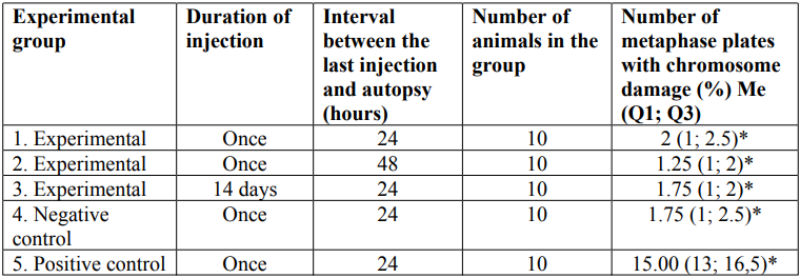
Notes: 1Me — median, (Q1; Q3) — quartiles (lower, upper).
*p<0.05 compared to the positive control group.
Despite the fact that collagen has low immunogenicity compared to most other proteins [25], the animal origin of this bioresorbable material raises increased concerns among practitioners regarding the allergic properties and safety of medical devices and drugs based on it in general.
In this paper, we studied the allergenic and genotoxic effects of the medical device COLLOST® reresorbable collagen material, gel» based on type I collagen from cattle hides. The study was performed on laboratory animals (mice, guinea pigs) in experimental models recommended by the regulatory documentation adopted at the legislative level in the Russian Federation, regulating the conduct of preclinical safety trials of medical devices and drugs. These models were proposed several decades ago [23, 26-28] and have long been standard for assessing the allergic and mutagenic properties of medical devices in vivo. The analysis of the allergenic effect carried out in various experiments showed that the medical product does not cause the development of immediate hypersensitivity in mice and guinea pigs with various sensitization schemes (course and three-time intradermal administration). Also, the method of maximum sensitizing effect did not reveal the ability of the gel to form immediate hypersensitivity in guinea pigs. Thus, the allergenic properties of the medical product in the experimental models used in vivo were not revealed. The obtained data indicate a low degree of allergenic activity of the components of the medical product, as well as in favor of a low risk of possible allergic reactions during its clinical use. However, when extrapolating the results obtained in this work on laboratory animals to humans, it is necessary to take into account published data that the nature of the immune response to collagen, as well as the localization of recognizable antigenic determinants on collagen tropomyces, may depend to a significant extent on the species of both the animal from which the collagen was obtained and the recipient animal of this protein [29]. Thus, clinical observation data indicate the presence of hypersensitivity to bovine collagen in injectable collagen implants in 2-4% of the human population [30-32].
A study of the genotoxic effect of the medical device COLLOST® did not reveal its ability to cause chromosomal aberrations in mouse bone marrow cells, either after a single or a course of intradermal injection. The result of the experiment, along with the data on the absence of allergenicity in in vivo, also supports non-allergenicity of the collagen gel. To date, no work has been published indicating the possible presence of any mutagenic activity in collagens of various types. The obtained experimental data on the absence of cytogenetic activity in the medical device under study fully correspond to this fact.



Write to us and our specialists respond as soon as possible