The most important task in cosmetology is the correction of agerelated and defective changes in the skin.
At the same time, correction procedures performed by cosmetologists are usually limited to the skin of the face and neck, as well as decollete area and hands. These procedures are aimed at maintaining hydration, even tone, tonus and turgor of exposed areas of the skin, which can be defined together by the term “skin quality”. Procedures that do not affect skin quality indicators are very often ineffective. That is why the technologies that improve the condition of integumentary tissues are taking a leading position in aesthetic medicine. The list of such technologies is quite wide. These include the use of external agents (peelings and cosmeceuticals), injection product sand instrumental treatments, and the use of biostimulating threads. All these methods are aimed at normalizing metabolic processes in the dermis and subcutaneous tissues, accelerating the synthesis and maintaining a sufficient level of hyaluronic acid and fibrous proteins, in particular, collagen.
The wide popularity of aesthetic medicine, the effectiveness and availability of methods for correcting aesthetic defects, and the correct use of sunscreens lead to the skin of the face and neck looking much younger and more well-groomed than the skin of closed areas of the body.
And our patients, who receive excellent aesthetic results in the face-neckdecollete area, begin to note that, for example, the inner surface of the shoulder and the elbow area also require the attention of a cosmetologist.
Recently, patients have increasingly turned to cosmetologists with a request to improve the appearance of not only the skin of the face, but the body as well. First of all, this is due to the culture of self-care and the desire to maintain youth and health. Procedures for restoring tone and rejuvenation, correcting flabbiness, and improving the appearance of skin in various areas of the body are becoming increasingly popular.
In our practice, we also note a significant increase in requests from patients for skin rejuvenation in various areas of the body. The most in-demand areas are: buttocks and inner thighs, inner shoulders, elbows and knees. It is worth noting separately the frequent requests for restoration of the tone of the tissues of the anterior abdominal wall after pregnancy and childbirth.
As already noted, a wide range of procedures are used to rejuvenate skin and improve its quality. The most desirable results of these
procedures include achieving an even tone, hydration of the skin and, most importantly, good tone and sufficient density of its tissues. The structural basis of the latter indicators are the proteins of the fibrous extracellular matrix, which form the mechanical framework of connective tissue and provide its volumetric, strength and elastic characteristics. The majority of methods for correcting age-related and aesthetic changes in the skin are based on maintaining a sufficient level of collagen in the dermis and hypodermis and maintaining the physiological rate of its metabolism. In other words, the main procedures for improving skin quality are aimed at collagen stimulation.
The importance of collagen in relation to the correction of changes in the skin is determined by the fact that it is the main structural component of connective tissue, which, in turn, serves as the structural basis of the entire body and the dermis, in particular [1]. Collagen makes up about a third of all proteins in the body. It has been shown that its content in the skin steadily decreases after 25–30 years.
This process is facilitated by a protein deficiency in the diet, a sedentary lifestyle, various somatic diseases, bad habits, and active insolation. Thus, we are faced with a complex multifactorial problem, which also needs to be solved in a comprehensive manner.
In order to achieve good results in facial and body aesthetics, it is important to develop comprehensive programs for patients aimed not only at working with integumentary tissues, but also at maintaining sufficient protein intake in the body, level of physical activity, correction of deficiencies, and normalization of work and rest regimes. In this case, the results of local anti-aging procedures will be much higher and longer lasting. Regardless of the method of stimulating the synthesis of one’s own collagen (this can be instrumental effects, injections of polylactic acid, calcium hydroxyapatite, installation of biostimulating threads), the functional activity of fibroblasts, the key cells of connective tissue, is of great importance. It is known that fibroblasts are responsible for the synthesis of glycosaminoglycans and fibrous proteins – the main components of the extracellular matrix. The speed and quality of renewal of the intercellular matrix depends on the number of fibroblasts in the tissue and their functional state. In turn, the state of the extracellular matrix directly determines the functional activity of cellular structures. Thus, in skin that has undergone age-related changes, a vicious circle is observed at the level of cellular physiology: Low fibroblast activity leads to a slowdown in the renewal of the dermal matrix, the accumulation of collagen subjected to secondary chemical modifications, and the disrupted collagen structure and imbalance of amorphous and fibrous components of the extracellular matrix lead to a decrease in fibroblast activity.
There are two different approaches that can be taken to break this vicious circle: renewing the pool of dermal fibroblasts or the intercellular matrix.
The first option is feasible by using cell therapy methods, but has many ethical, immunological and economic problems. At the same time, there are all the possibilities for implementing the second approach – restoring the structure of the intercellular matrix of the dermis.
In our practice, we use the COLLOST® product line[2, 3] to renew the collagen framework of the dermis. Collagen in these products is not only and not so much a building material for replacement therapy and for increasing the fiber content in the dermis, it is primarily a matrix or basis for targeted tissue regeneration by creating support for fibroblasts, which need fibrous proteins as an adhesive substrate or, figuratively speaking, “rails” for targeted migration to those zones and areas that require their increased activity.
In regenerative medicine, the product COLLOST® has been used since 1999, in dermatology and cosmetology – since 2005. During this time, the product has proven itself as an effective and safe product for the restoration of the dermis and connective tissue in various clinical situations in general.
It is important to focus on choosing a product from the line for a specific clinical situation. For patients with age-related atrophic skin, the product of choice is COLLOST® micro, since it creates conditions for maximum stimulation and revitalization of fibroblasts through the use of MICRONONIC® and PoliONICol® technologies [4, 5].
For patients with dense skin, for young patients, the product of choice may be COLLOST® gel with different percentages of collagen content.
It is necessary to note some features of the use of collagen preparations when using them in skin correction procedures in the body area. It is important to remember that collagen preparations have a dose-dependent effect, which is due to the large size of its molecules, complex structure and inability to diffuse. In other words, the more densely the product is “laid” onto the tissue area, the better the effect of matrix renewal and fibroblast activation will be. There is a general rule: In case of significant age-related changes, 1.5 ml of COLLOST® gel or a bottle of the product (150 mg) COLLOST® micro should be injected into an area of tissue corresponding to the size of a palm (7×7 cm). If the changes are moderate, then a similar volume of the preparation can be distributed over an area corresponding to two palms (approximately 15×7 cm).
Based on the data provided, in our practice we use 3 bottles (450 mg) of the product COLLOST® micro to treat the aesthetic zone. This volume is sufficient for high-quality treatment of the inner surface of the shoulders or thighs, the buttocks or abdomen (Fig. 1).
The injection technique is papular or tuberculous at the level of the dermis. We use needles with a diameter of 32G and a length of 4 mm. We perform injections to a depth of about 2 mm. It is important to note the frequency of procedures. We notice the effect of collagen preparations associated with the normalization of the metabolism of own fibrous structures 3–4 weeks after the procedure. During approximately the same time, the body’s own proteolytic enzymes destroy the injected collagen. Therefore, we recommend performing procedures at intervals of 4-5 weeks. The number of procedures is selected individually; as a rule, the course includes 3–4 procedures. We also recommend that patients undergo maintenance procedures to maintain and prolong the results once every 3–4 months. In our practice, to achieve optimal results, we create combined programs that include collagen therapy with the product COLLOST®, instrumental methods, thread lifting, and the use of collagen stimulators based on polylactic acid [6].
It is possible to identify some principles for compiling such programs. The more pronounced the tissue atrophy is (postmenopause, protein deficiency, presence of stretch marks, signs of connective tissue dysplasia), the more important it is for us to start with restorative therapy of the dermis using preparations from the COLLOST® line. In such cases, at the beginning of the course, we recommend at least 2-3 procedures and only then prescribe aggressive instrumental methods or use collagen stimulants based on poly-L-lactic acid. The same applies to thread lifting – for optimal fixation in tissues, for sufficient development of the biostimulating effect of threads based on polylactic acid, we first conduct a course of collagen therapy with the product COLLOST®.
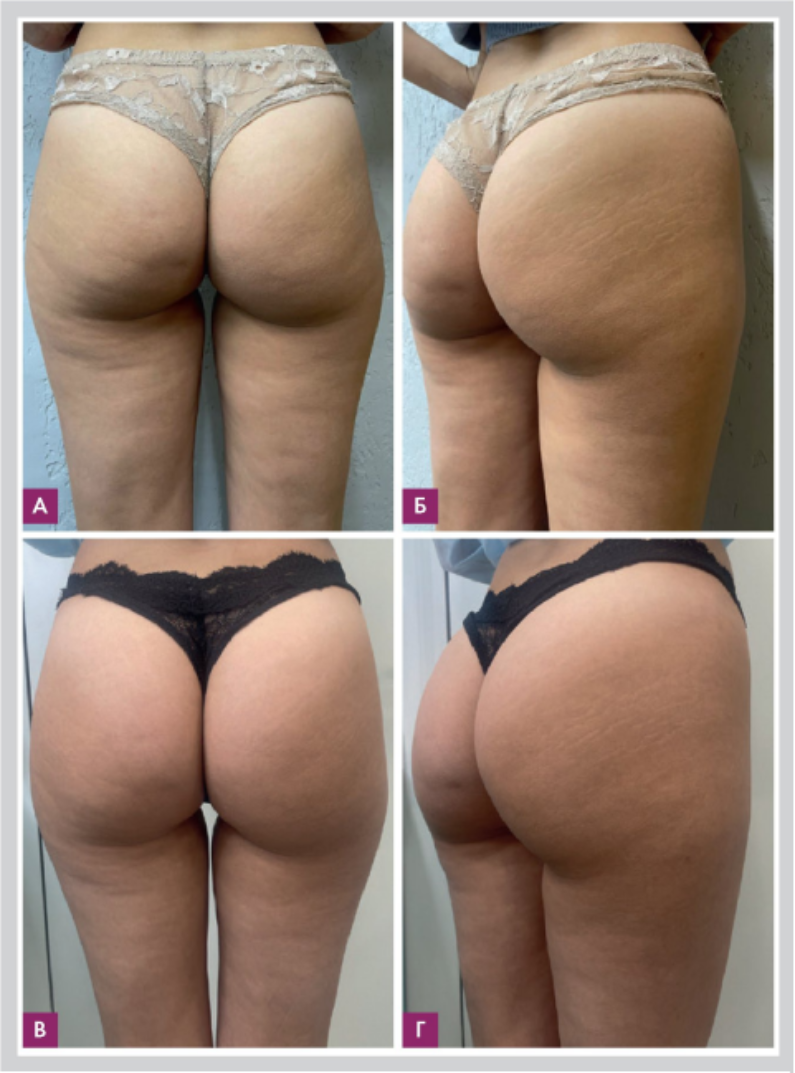
Fig. 1. Correction results after 3 procedures with COLLOST® micro: before (A, B) and after (C, D) the course of procedures. 450 mg of the product was injected during each session.
In conclusion, I would like to note the need to develop comprehensive programs for rejuvenation of not only the skin of the face and neck, but also for the skin of various areas of the body, the central place in which should be given to the restoration of the fibrous extracellular matrix of connective tissue in general and the dermis in particular using injectable collagen-based preparations.

Write to us and our specialists respond as soon as possible