
Patients with eczema increasingly consult a cosmetologist during the inter-relapse period of the disease to correct dry skin and stimulate epithelialization of erosions. As a solution to these problems, therapy with native collagen is recommended.
Eczema is a widespread skin disease, which is considered the most common pathology (30–40%) detected during a dermatologist’s appointment.
Pathohistologically, in eczema the most characteristic changes are observed in the epidermis: exoserose, exocytosis, spongiosis and acanthosis. The combination of spongiosis and parakeratosis explains the most typical clinical symptoms of this disease — vesiculation and oozing. In the dermis, inflammatory phenomena are revealed in the form of dilation of blood and lymphatic vessels, exudation and accumulation of perivascular cellular infiltrate in the papillary layer of the skin. The infiltrate consists mainly of lymphocytes, with smaller amounts of fibroblasts and histiocytes, and single polynuclear leukocytes. Swelling of collagen and elastic fibers and their separation are observed. In some places in the area of infiltrate accumulation there are also degenerative processes of connective tissue, which is expressed in a change in its fibrous structure.
Recently, cosmetologists have increasingly taken part in working with eczema at the recovery stages. Patients come with complaints of dry skin of hands, mainly in the palm area, long-term non-healing cracks, erosions, peeling erosions, peeling. When working with such patients, the doctor needs to clarify the presence of a history of rashes on the hands skin, appearance of severe itching and blisters on the skin, reactions to detergents, cold, and food products.
Considering the polyetiology of the disease, the tendency for frequent recurrence of the process, as well as the decrease in reparative processes and the barrier function of the skin, which is manifested by long-term cracks and dryness even during remissions, cosmetic procedures are justified after the exacerbation has been relieved.
Native collagen preparations stimulate tissue regeneration, promoting the migration of macrophages and fibroblasts to the area of damage, in the case of eczema — to the area of cracks and erosions. As a result, chemotaxis is activated, proliferative and secretory activity of cellular elements increases, and angiogenesis is stimulated. The expression of genes of the proinflammatory cytokine IL1B, metalloproteinase MMP1, PDGF decreases, and the expression of vascular endothelial growth factor increases.
COLLOST® Micro collagen therapy has shown high efficiency, good tolerability, and prolongation of remission in eczema and is recommended for use between relapses of the disease.
There is an increase in the migration of macrophages and an increase in their transformation into M2 macrophages, which triggers a cascade of reparative processes. Thanks to the patented MicronONIC® technology, COLLOST® Micro product provides regeneration and neocollagenesis, and the PoliONICol® technology provides tissue hydration.
As a result of the study conducted at the preclinical stage at the Institute of Immunology of the Federal Medical and Biological Agency of Russia, it was shown that COLLOST® Micro does not have a sensitizing effect.
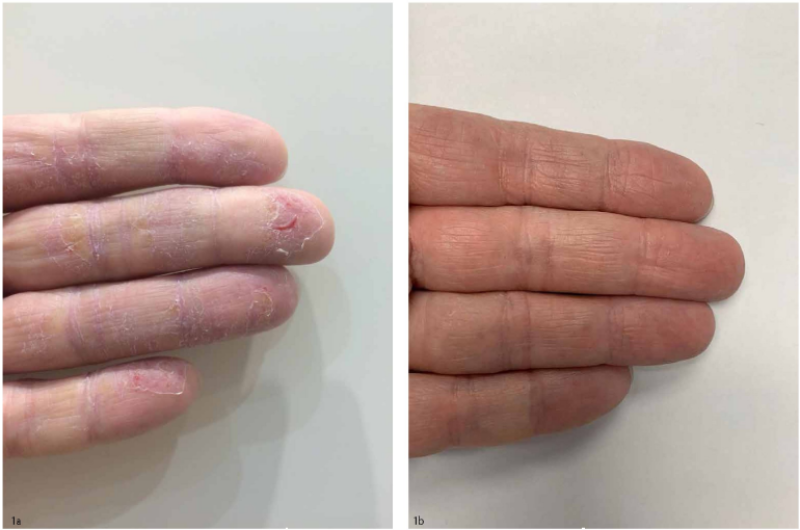
Photo 1. Patient — man, 43 years old. A — before the procedure, b — after 56 days
Patient — man, 43 years old. He visited us with complaints of dry skin and long-term non-healing cracks, pain when bending his fingers. It is known from the history that he has been suffering from dyshidrotic eczema for more than 20 years. In the last year, he has noted slow healing of wounds and cracks (persisting for more than two months) in the inter-relapse period. Inspection: the process is localized on the right and left palms. The skin is dry, thinned, erosions and cracks are observed.
Subjectively: feeling of tightness.
The number of procedures is three, the interval between the procedures is three weeks.
The results of the procedures were assessed using the Aramo MC device (determination of skin hydration indicators), photo documentation (before and after the course of procedures after three weeks) and a patient survey using the GAIS satisfaction scale. The clinical effect assessment took into account healing of cracks and scars, skin thickening and hydration, and the presence of signs of exacerbation.
Three weeks after the first collagen therapy procedure, epithelialization of cracks and erosions was observed. The result in the form of skin thickening, improved color, complete epithelialization and hydration increased as a result of the course of procedures and persisted three weeks after the third procedure. The patient noted rapid healing, which had not been observed previously.
According to Aramo MC, the moisture level before the procedures on the right hand (middle of the palm) was 21.5, on the left hand — 23.4. After the course of procedures: 32.5 on the right hand, 33.2 on the left hand. According to GAIS, satisfaction with the procedure results is three points, from the doctor’s side – three points.
Write to us and our specialists respond as soon as possible