Pathological scarring of the skin after plastic surgery is an important issue in the field of aesthetic medicine. COLLOST® gel 15 % ensures healing by creating a complete collagen matrix, which helps normalize synthetic and proliferative processes in the scar.
If a patient seeks help from plastic surgeons to achieve an aesthetic appearance, the appearance of a hypertrophic, keloid scar leads to disappointment. The tendency to develop keloid scars is usually genetically determined and is currently most often corrected with glucocorticosteroids [1].
In general, methods for treating hypertrophic and keloid scars are currently being actively developed. For this purpose, various instrumental techniques, applications of silicone-based patches and creams, the introduction of platelet-rich plasma, botulinum toxin, and preparations based on hyaluronic acid are proposed [2]. However, to date, a method with 100% efficiency has not been proposed, which determines the relevance of research in this area.
The introduction of collagen products COLLOST® is a promising method for normalizing the course of reparative processes in connective tissues. Previously, various experimental studies have shown that these products in regenerating skin tissues are capable of reducing the expression of genes of the proinflammatory cytokine IL-1b and matrix metalloproteinase MMP-1, normalizing the dynamics of vascularization in the area of damage, increasing the number of CD163-positive M-2 macrophages [3], and reducing excessive growth of granulation tissue [4]. It has also been clinically shown that COLLOST® reliably promotes the formation of a healthy scar after a cesarean section [5].
This paper presents the first description of a clinical case of successful treatment of hypertrophic scars on the skin after mammoplasty using local injection of the COLLOST® gel product.
Therapy using collagen preparations may be promising in the presence of signs of hypertrophic scar formation, as well as in patients with a history of impaired scarring.
Patient — woman, 56 years old. Complaints about scars after the third remammoplasty (three months after the operation).
From the history: 10 years ago, an abdominoplasty was performed with the formation of a wide scar, two years ago a facelift was performed with the formation of hypertrophic scars, also two years ago breast lipofilling was performed, after which oleogranulomas formed, followed by mammoplasty (removal of oleogranulomas, installation of implants), six months later — a repeat mammoplasty due to suture divergence and displacement of implants, a year later — a third remammoplasty with removal of implants and removal of hypertrophic scars [Photo 1]


Photo 1. Before the third remammoplasty (12 months after revision mammoplasty)
From the somatic history: connective tissue dysplasia, high risk of premature skin aging [6].
On examination, pronounced hyperemia of the scar and capillary growth in the scar area were noted [Photo 2]. This condition is typical for the formation of a hypertrophic scar, whereas with physiological healing, already three months after skin damage, remodeling of the scar should be observed, which is characterized by its reduction, acquisition of a white color due to the disappearance of hyperemia and growing vessels [7].
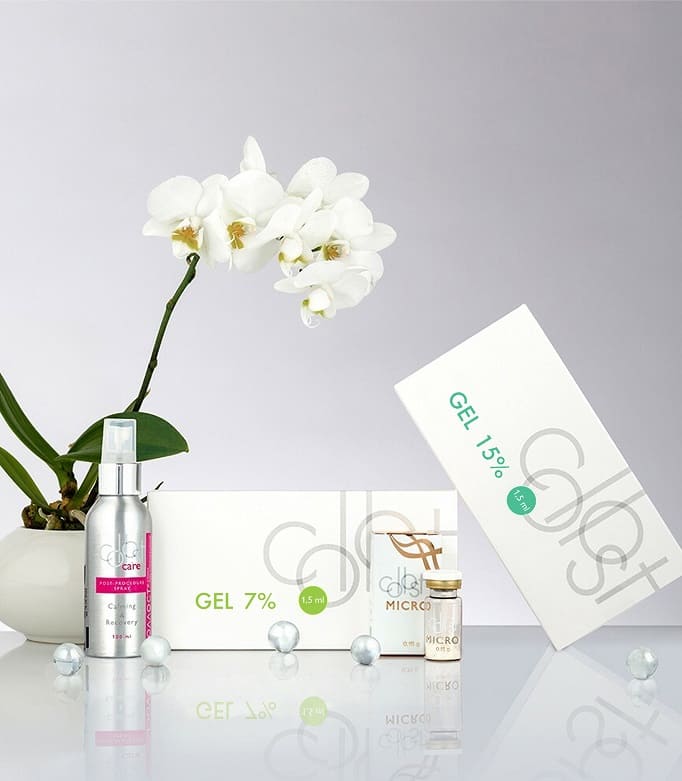
The product COLLOST® gel 15 %, 1.5 ml was selected for correction. Composition: native collagen fibrils 15 % in glucose solution.


Photo 2. Three months after the third remammoplasty
Protocol of the procedure
Double treatment of the correction area with an aqueous solution of chlorhexidine.
Application anesthesia, Emla cream, 30 minutes.
Preparation of the product COLLOST® gel 15 %: heating in a thermos at a water temperature of 45 °C until the gel becomes liquid (15–20 minutes).
After removing the application anesthesia and treating the area of exposure, the product of choice is injected along the entire scar tissue (periareolar area, vertical scar along the skin of the mammary gland, horizontal scar under the mammary gland).
Injections using the tubercle technique, at a depth of 1.5-2 mm, with a distance of 5-7 mm.
Post-procedure care — COLLOST® spray. Spray onto the correction area from a distance of 20-25 cm for quick relief of irritation, anti-inflammatory action and strengthening of the skin’s natural barrier.


Photo 3. 28 days after the first procedure with COLLOST® gel 15 % (4 months after the third remammoplasty)
The initial effect was noted after the first procedure: reduction of hyperemia, decrease in the number of visible capillaries [Photo 3]. There is also no progression of hypertrophic scar formation.
Currently, four collagen therapy procedures have been performed. In the postoperative area, white normotrophic scars are noted, which indicates a physiological scarring process [Photo 4].


Photo 4. After four collagen therapy procedures, 5 months after the start of treatment (8 months after the third remammoplasty)
Thus, this clinical example shows that the use of collagen therapy with the product COLLOST® gel 15 % helps to normalize scarring processes. It is assumed that when administered intra-scar, the native collagen structure of COLLOST® Gel is replaced by newly formed collagen fibers.
The pathophysiological action of native collagen creates optimal conditions for the migration and implantation of fibroblasts, improves their intercellular interaction, after which further physiological processes are launched that underlie the resulting effect.
Write to us and our specialists respond as soon as possible