O.V. Zabnenkova, O.Y. Pavlenko. Clinical experience of the treatment of atrophic scars with the use of the material for injection contour plasty — COLLOST® gel 7% // Plastic Surgery and Cosmetology. 2010(4) Atrophic scars occur as a result of injuries, inflammation or iatrogenic influence. The generally recognized methods of correction of scarry changes are fractional prtotothermolYSis, dermabrasion and other types or dermal resurfacing. Injection of the COLLOST® gel (7%) allows achieving a pronounced effect in the treatment, of atrophic scarry skin deformations.
Treating atrophic scars can be challenging. In our work, we used COLLOST® 7 % gel (Niarmedik Plus LLC, Russia), containing non-reconstructed type 1 collagen with a preserved three-helix fiber structure. It has been shown that the introduction of the gel into the wound area activates a complex cascade of cellular reactions: strengthening of the macrophage reaction, proliferation of native fibroblasts and synthesis of native collagen, accelerated formation of granulation tissue and restoration of the normal structure of the dermis [1]. These properties of collagen make it possible to use it for the treatment of atrophic deformities of various origins [2, 3].
Patient N., 30 years old, visited the cosmetology department of MS Detal LLC with complaints of deformation (sagging) of the soft tissues of the ridge of the nose, which formed at the site of application of the fixing plaster cast after rhinoplasty. History. On the 2nd day after surgery, the patient felt itching and pain in the area of the ridge of the nose. Due to increasing subjective sensations, the plaster cast was removed on the 3rd day. During examination, an atrophic defect of the soft tissues in the central part of the bridge of the nose was identified in the form of a depressed concentric “insular” scar with a diameter of 2 cm with pronounced erythema (Fig. 1a).
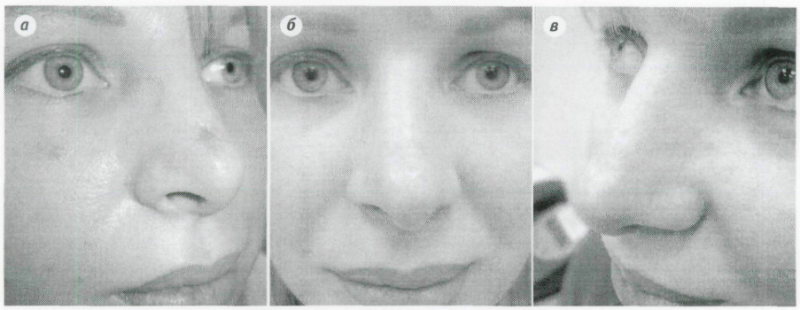
Fig. 1. Patient N., 30 years old: skin atrophy formed at the site of application of the fixing plaster cast after rhinoplasty (a); result of COLLOST® 7 % gel injections (10 procedures) (6) and 3 IPL-mepanuu sessions (in).
Initially, the patient received only external therapy (Celestoderm B cream and Solcoseryl cream — 2 times a day) to relieve inflammation and accelerate reparative processes. From the 10th day of the rehabilitation period, a decision was made to conduct additional injection therapy with COLLOST® 7 % gel to restore the soft tissue deficit and correct post-traumatic atrophic deformation of the nose. The course of treatment consisted of 10 sessions, the procedures were carried out every 2-4 weeks (1-3 sessions within 2 weeks, the following ones – once a month). COLLOST® gel was injected directly into the atrophic zone in a volume of 0.1-0.2 ml with deliberate hypercorrection.
Side effects after the procedure include: bright diffuse hyperemia, a feeling of distension and burning, which disappeared on their own within the first day after the procedure and did not require additional therapy After 4 months, a pronounced clinical effect was achieved — lifting the bottom and smoothing the atrophic cicatricial deformation of the skin of the ridge of the nose (Fig. 1b). At the next stage of treatment, IPL therapy was prescribed to the patient to eliminate persistent erythema and telangiectasias. Three phototherapy sessions were performed (every 2 weeks) using the IPL Quantum device (Lumenis, USA), the intensity of exposure was 30-31 J (Fig. 1c). Thus, as a result of the combined therapy, a pronounced clinical effect was achieved in the treatment of post-traumatic skin atrophy (Fig. 16).
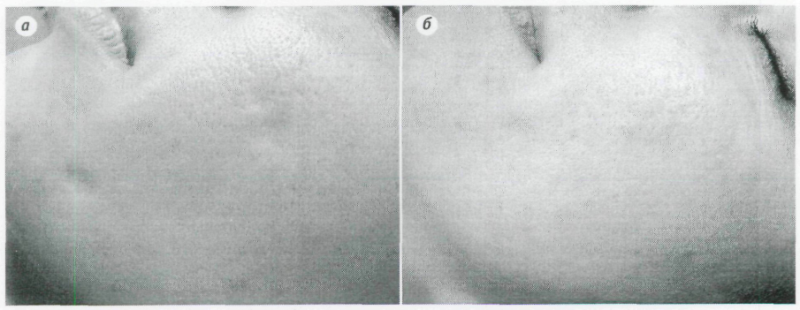
Fig. 2. Patient L., 32 years old: skin atrophy after administration of Dipraspan (a); results of treatment with COLLOST® 7 % gel (3 sessions) (b).
Patient L., 32 years old, complained of sunken skin in the cheek area, the appearance of which she associated with the administration of the product Diprospan. Intradermal injections of prolonged steroids were prescribed to the patient to resolve the infiltrative elements of acne. On examination: the skin process is local, non-inflammatory in nature, represented by single oval atrophic lesions with a diameter of 4-6 mm, with clear contours and single telangiectasias localized in the area of the right and left cheeks (Fig. 2a). To restore the skin structure and fill the atrophic defect, the patient underwent injection therapy with COLLOST® 7 % gel. The product in a volume of 0.25-0.3 ml was injected into each lesion, directly into the bottom of the atrophy until hypercorrection was achieved. Additionally, immediately before the introduction of COLLOST® gel, the bottom of the atrophic deformation was separated from the underlying tissues. A 27G needle was used for this. 8 sessions were conducted. As a result of the therapy, complete correction of atrophic changes in the skin was achieved (Fig. 26).
Atrophic changes in the skin due to trauma, infection, and iatrogenic effects are quite common in clinical practice. In the cases cited, the causes of cicatricial skin atrophy were a plaster cast applied after rhinoplasty and a violation of the method of administration of prolonged steroids. The results of the therapy have proven the effectiveness of COLLOST® 7 % gel in the treatment of atrophic scars. However, the use of this product has a number of features:
• Considering the possible risk of allergic reactions, an intradermal allergy test should be performed 14 days before the start of treatment;
• to enhance the clinical effect, immediately before the administration of the product, it is recommended to separate the cicatricial deformities from the underlying tissues;
• COLLOST® gel should be administered until hypercorrection is achieved, and the required volume of the product may vary and depends on the atrophic defect severity;
• injections of the product COLLOST® should be carried out as early as possible (possibly even before epithelialization), the number of sessions should be determined individually — until the clinical effect is achieved;
• It is recommended to combine this therapy with other generally accepted methods of scar treatment (fractional thermolysis, dermabrasion, phototherapy, etc.).
Declaration of material incentive. The authors have no financial interests whatsoever. The product was paid for by patients, and the article presents the personal experience and observations of the authors.
Write to us and our specialists respond as soon as possible