How to remove creases on the face is a pressing question for many people facing this aesthetic concern. A facial crease is a deep fold or furrow that forms as a result of prolonged exposure of the skin to various factors. Unlike superficial wrinkles, creases affect deeper layers of the dermis and require a professional approach to correction.[1]

What’s the Difference Between a Crease and a Wrinkle?
Understanding the differences between creases and wrinkles is important for choosing the right treatment approach:
Wrinkles:
- Superficial skin changes
- Primarily affect the epidermis and upper dermal layers
- Can be dynamic (appear with facial expressions) or static
- More easily corrected in early stages[2]
Creases:
- Deep structural skin changes
- Affect all layers of the dermis and subcutaneous tissue
- Always static – visible at rest
- Require more intensive intervention for correction[1]
What Causes Facial Creases?
Age-Related Changes
The primary cause of crease formation is natural skin aging, which is accompanied by:
- Loss of skin elasticity and firmness
- Decreased collagen and elastin synthesis after age 25
- Skin thinning and reduction of subcutaneous fat
- Dryness and disruption of the hydrolipid balance[1]
Gravitational Ptosis
Under the influence of gravity, the following occurs:
- Sagging of facial soft tissues
- Deformation of facial contours
- Deepening of natural folds
- Formation of new creases in areas of greatest tension[3]
Facial Expression Activity
Expression lines eventually transform into creases due to:
- Constant contractions of facial muscles
- Formation of persistent folds in areas of active facial expressions
- Weakening of skin’s supporting structures[2]
Creases on Skin After Sleep
Formation Mechanism
Sleep creases form as a result of:
- Prolonged pressure of the pillow on facial skin
- Friction of skin against bedding
- Improper head position during sleep
- Insufficient skin elasticity for self-recovery[4]
Characteristics of Morning Creases
How to remove facial creases after sleep depends on their nature:
- In young people, creases disappear within 30-60 minutes
- With age, recovery time increases
- Pillow creases on the face may persist for several hours
- Regular repetition leads to formation of permanent folds[4]
Crease Localization
Creases around the mouth:
- Nasolabial folds – from the nose wings to mouth corners
- Marionette lines – from mouth corners downward
- Perioral wrinkles – around the mouth
- Creases on the chin and mentolabial fold area[3]
Other localization zones:
- Under the eyes – tear trough and malar bags
- On the forehead – horizontal and vertical creases
- In the neck and décolletage area
- Glabellar zone – vertical folds[2]
Prevention of Crease Formation
Proper Sleep
How to remove skin creases on the face related to sleep:
- Sleep on your back to minimize contact with the pillow
- Use silk or satin pillowcases
- Choose orthopedic pillows of proper height
- Regularly change head position during sleep[4]
Skin Care:
- Use of moisturizing products
- Application of creams with retinol and peptides
- Facial massage to improve circulation
- Protection from ultraviolet radiation[5]
Healthy Lifestyle:
- Adequate water consumption
- Balanced diet with antioxidants
- Smoking cessation and alcohol limitation
- Regular physical activity[5]
Can Skin Creases Be Smoothed?
Home Methods
Superficial creases can be reduced through:
- Intensive skin hydration
- Massage using oils
- Facial exercises
- Application of masks with collagen and hyaluronic acid
Professional Correction Methods
Injectable Techniques:
- Hyaluronic acid-based fillers to fill creases
- Biorevitalization and mesotherapy to improve skin quality
- Botulinum toxin injections to relax facial muscles
- Collagen therapy to restore the collagen framework[6]
Device-Based Procedures:
- Laser resurfacing to renew skin surface
- RF-lifting for tissue tightening
- Ultrasound facial lifting
- Microcurrent therapy for muscle stimulation[7]
COLLOST® Collagen Therapy – A Proven Solution
When standard preventive methods prove insufficiently effective and facial creases become well-defined lines and folds, modern collagen therapy comes to the rescue[8].
Injectable collagen administration is widely used in aesthetic cosmetology to compensate for structural protein deficiency in the dermis[8].
COLLOST® preparations, created from natural native collagen (with fully preserved natural molecular structure) of animal origin, not only restore skin structure but also activate the function of fibroblasts – cells responsible for producing the body’s own collagen.[9]This provides the body with necessary building material for natural synthesis of collagen fibers.
Thus, COLLOST® acts on three levels:
- Forms a new skin framework
- Triggers synthesis of the body’s own collagen
- Serves as building material for regeneration
After a course of COLLOST® subcutaneous injections, skin acquires greater firmness, becomes smooth and radiant, and deep creases and folds are significantly smoothed and become less noticeable.[9]
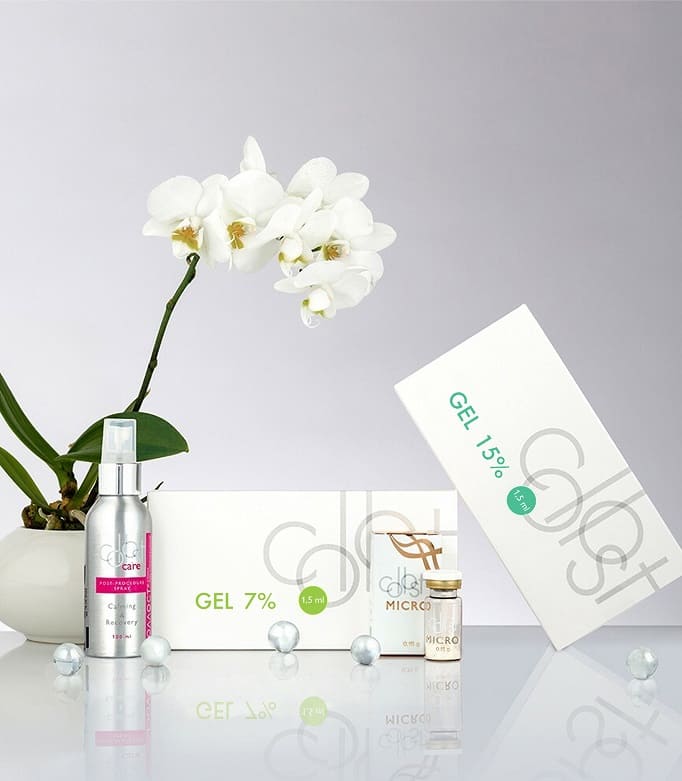
COLLOST® contains the maximum collagen concentration on the global market — 15%.
COLLOST® is available as micronized powder COLLOST® micro and as gel COLLOST® gel 7% and COLLOST® gel 15%. The preparations can be injected into the upper and lower eyelid skin up to the lash line.
COLLOST® micro is based on unique patented PoliONICol® and MicronONIC® technologies.
PoliONICol® technology (Polianionic Outstanding Native Innovative Collagen) enhances the hydrating properties of collagen.
MicronONIC® microstructuring technology (Micronized Outstanding Native Innovative Collagen) allows formation of material consisting of interwoven thread-like biomimetic particles. Capillary spaces between microfibers attract and retain water, facilitate cell penetration into the material’s depth. The fibrous structure of microparticles serves as both a biological and mechanical activator of the regeneration process, stimulating neocollagenogenesis.
Advantages of Collagen Therapy
- Naturalness – use of natural collagen
- Safety – minimal risk of allergic reactions[11]
- Long-term effect – stimulation of the body’s own collagenogenesis
Features of Crease Correction in Different Zones
Nasolabial Creases
Nasolabial creases on the face require a combined approach:
- Correction of midface volume
- Filling folds with fillers
- Stimulation of collagen production
- Improvement of skin tone[3]
Periorbital Zone
Under-eye creases are corrected with particular caution:
- Use of special injection techniques
- Low-viscosity preparations
- Minimal volumes to prevent swelling
- Targeted correction of problem areas[2]
Forehead Area
Forehead creases often combine with brow ptosis:
- Correction of horizontal folds
- Relaxation of facial muscles
- Upper face tissue lifting
- Volume restoration in temporal areas[7]
Contraindications to Crease Correction
Absolute Contraindications:
- Acute inflammatory processes on facial skin
- Oncological diseases
- Blood clotting disorders
- Pregnancy and lactation period[10]
Relative Contraindications:
- Tendency to form keloid scars
- Taking anticoagulants
- Exacerbation of chronic diseases
- Menstruation in women
Treatment Prognosis and Results
Expected Effects
- Significant smoothing of deep creases
- Improvement of skin texture and tone
- Restoration of clear facial contours
- Overall rejuvenation and fresh appearance
Duration of Results
- Fillers – 8-18 months depending on zone
- Collagen therapy – up to 12 months with cumulative effect
- Device-based procedures – 6-12 months
- Combined methods – up to 2 years with proper care
Recommendations for Maintaining Results
Home Care:
- Regular use of moisturizing products
- Application of SPF 30+ sunscreen
- Facial massage to maintain tone
- Use of cosmetics with active ingredients
Professional Support:
- Maintenance procedures every 6-12 months
- Regular consultations with cosmetologist
- Adjustment of care program as needed
- Preventive device-based procedures
Innovative Crease Correction Methods
Combined Protocols
Modern cosmetology offers comprehensive programs:
- Combination of injectable and device-based methods
- Staged correction with intervals
- Individual selection of preparations and techniques
- Results monitoring at each stage
Personalized Approach:
- Consideration of individual skin characteristics
- Analysis of patient’s lifestyle and habits
- Program adjustment depending on results
- Long-term planning of maintenance procedures
Conclusion
How to remove creases on the face? Modern aesthetic medicine offers a wide range of correction methods, from preventive measures to innovative injection technologies. The key to success is timely consultation with a specialist, proper diagnosis of crease formation causes, and selection of an optimal treatment program.
Collagen therapy with COLLOST® preparations represents a modern solution for correcting facial skin creases, providing not only immediate aesthetic effect but also long-term improvement in skin quality. It’s important to remember that the best results are achieved with a comprehensive approach, including professional procedures, proper home care, and a healthy lifestyle.
References
- Korolkova T.N. Human aging in light of modern theories / T.N. Korolkova // Collection of articles of NPO of cosmetologists of St. Petersburg. – Issue 2. – 2001. – pp. 6–16.
- Meshchaninov V.N. Metabolism of cellular structures during aging and stress / V.N. Meshchaninov, D.L. Shcherbakov, V.A. Lukash. — Yekaterinburg: USMU Publishing House, 2017. — 308 p.
- Hee K.C., Seo K.K., Lee H.-K., Kim C. Clinical anatomy of the face as applied to contour plasty using fillers and botulinum toxin / Ed. by I.E. Khrustaleva. – Moscow, 2022. – 192 p.
- Adler Y. What skin hides. M.: Eksmo, 2017 (electronic version from OOO «Publishing House «E»», 2017).
- Goncharova T.A. Beauty secrets. M.: Kron-press, 1997.
- Demyanenko I.A., Shishkina A.V., Kalmykova N.V. Collagen-based injectable implants for use in cosmetology and aesthetic medicine: review of preparations presented on the Russian market // Injectable Cosmetology. – 2020. – 3. – pp. 32–39.
- Barinova A.N., Ponomarev I.V. Modern device-based methods in aesthetic medicine // Plastic Surgery and Cosmetology. – 2018. – 3. – pp. 15–24.
- Kapuler O.M. Theoretical aspects and clinical principles of collagen therapy in cosmetology / O.M. Kapuler // Injectable Methods in Cosmetology. — 2013. — 1. — pp. 100-109.
- Application of COLLOST® gel 7% collagen complex for correction of involutional-depressive changes of facial skin, neck, décolletage, shoulders: methodological recommendations / O.S. Panova. — M., 2014. — 15 p.
- Olisova O.Yu., Teplyuk N.P. Contraindications to cosmetic procedures // Russian Journal of Skin and Venereal Diseases. – 2019. – 22(1). – pp. 67–74.
- Patent 2353397. Russian Federation. Bioresorbable collagen matrix, method for its production and application / A.A. Safoyan, S.V. Nesterenko, V.G. Nesterenko, N.Yu. Alekseeva. Applicant CJSC «BioFARMAKHOLDING» – 2007113962/15; filed 13.04.2007; published 27.10.2008, Bull. 30.